

claude-bughunter
A self-contained Claude skill bundle for bug hunting and external red-team work · 85 skills · 16 slash commands · 681 disclosed-report patterns (433 now individually cited & auditable) across 24 core vulnerability classes · enterprise identity + infrastructure attack matrices · engagement-folder scaffolding · Burp MCP integration · battle-tested across authorized red-team and bug-hunting engagements, plus public training platforms (DVWA, OWASP Juice Shop, Hacker101, testphp.vulnweb.com).
Built by Sachin Sharma — Bug Hunting & GenAI Security Research.
SPONSORED BY


What is this?
claude-bughunter is a drop-in skill bundle for the Claude Code skills system. Install once and Claude Code stops being a chatbot and starts behaving like a senior bug-hunting researcher or red-team operator: it knows the techniques, the chain templates, the VRT mappings, the platform CVE chains, and the hygiene — and it stays in scope.
Four layers stack:
- Think —
bb-methodology+redteam-mindset: the 5-phase non-linear workflow, critical-thinking framework, and red-team operator discipline. - Hunt webapps — 58
hunt-*skills curated from 681 disclosed HackerOne reports: per-class detection patterns, payloads, bypass tables, and chain templates. - Hit the perimeter — enterprise platform chains (M365/Entra, Okta, vCenter, SSL-VPN appliances, SharePoint, cloud IAM): current 2024–2026 CVE chains + post-credential escalation.
- Ship it —
triage-validation+ reporting +evidence-hygiene: the 7-Question Gate, VRT-aware severity, OOS rebuttals, PII redaction, and red-team deliverables.
All triggered automatically by topic — describe what you’re testing in plain English and the relevant skill loads. No invocation by name.
Quickstart
Option A — install as a Claude Code plugin (recommended). From inside Claude Code:
/plugin marketplace add elementalsouls/Claude-BugHunter
/plugin install claude-bughunter@elementalsouls
All 85 skills + 16 commands load namespaced under claude-bughunter: and update when you bump the plugin version — no files copied into ~/.claude/.
A HackerOne account is optional. The install asks for a HackerOne API username and token. They only let the HackerOne MCP read your private programs and your own reports; leave both blank if you don’t need that. Every skill, command and the MCP’s public tools (duplicate search, program scope) work without them.
Option B — copy install (no plugin system / pin to a clone):
git clone https://github.com/elementalsouls/Claude-BugHunter.git
cd Claude-BugHunter
# macOS / Linux
bash scripts/install.sh

# Windows (PowerShell)
pwsh ./scripts/install.ps1
Both copy the skills + commands into ~/.claude/ (macOS/Linux) or %USERPROFILE%.claude (Windows) and wire the hunt engagement scaffolder.
What each install path gives you:
| Path | 85 skills + 16 slash commands | cbh CLI |
hunt scaffolder |
|---|---|---|---|
| A — plugin | ✅ namespaced under claude-bughunter: |
➕ separate pipx install |
❌ clone-only |
| B — copy install | ✅ copied into ~/.claude/ |
✅ from the clone | ✅ from the clone |
The plugin is the fastest path to the skills + slash commands. The terminal-native
cbh runner installs standalone — pipx install claude-bughunter (or pipx install git+https://github.com/elementalsouls/Claude-BugHunter for the tip of main)
— so plugin users can add it without a full clone (see cbh CLI).
The hunt engagement scaffolder ships with the clone (Option B).
That’s it. Open Claude Code and describe what you’re testing in plain English — the right skill loads automatically, no invocation by name:
> Testing acme.com — an in-scope HackerOne target. Run recon and rank the surface.

  ⟳ loading skills: web2-recon, offensive-osint, bb-methodology …
    → subdomain enum (subfinder + crt.sh) … 47 hosts
    → live hosts (httpx) … 12 · tech fingerprint … 6 distinct stacks
    → ranked surface: api.acme.com (GraphQL, introspection ON)  ← start here
                      auth.acme.com (OAuth, SSO)               ← hunt-oauth

  Next: want me to probe the GraphQL introspection + OAuth redirect_uri?
→ Full Installation guide · Usage guide · searchable skill catalog.
The block above is an illustrative transcript. To record a real demo of your own session:
asciinema rec demo.cast→ upload to asciinema.org and drop the badge here.
Runs on multiple agent harnesses

The skills are plain Agent Skills — the same SKILL.md format that Claude Code · OpenCode · OpenAI Codex CLI · Hermes Agent · Google AntiGravity all load. One command installs them everywhere:
# macOS / Linux
bash scripts/install.sh --all --burp-mcp

# Windows (PowerShell)
pwsh ./scripts/install.ps1 -All -BurpMcp
| Harness | Target Skill Directory | Flag |
|---|---|---|
| Claude Code (baseline) | ~/.claude/skills/ |
(default) |
| OpenCode | reads ~/.claude/skills/ & ~/.agents/skills/ |
(default) / --agents |
| OpenAI Codex CLI | ~/.agents/skills/ |
--agents |
| Hermes Agent | ~/.hermes/skills/ |
--hermes |
| Google AntiGravity | ~/.gemini/config/skills/ |
--antigravity |
--all (-All) detects installed harnesses and copies skills to each harness’s path (~/.claude/skills, ~/.agents/skills, ~/.hermes/skills, ~/.gemini/config/skills); --burp-mcp (-BurpMcp) wires the Burp MCP server into each. The full knowledge layer ports to all five — the slash commands and /hunt engine stay Claude-Code-only by design.
Star History
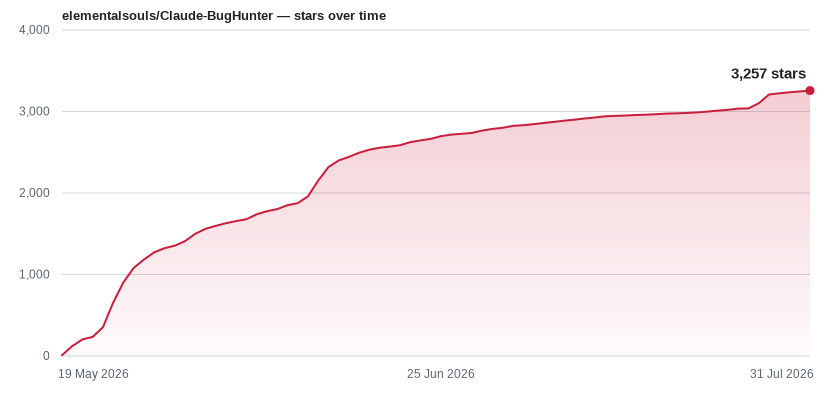
Chart is self-hosted — regenerate with python3 scripts/gen_star_history.py (needs gh auth login).
Refreshes automatically each day via .github/workflows/star-history.yml.
Scope — what this bundle is for, and what it isn’t
This bundle covers the external attack surface — anything reachable from the internet without first compromising an internal endpoint.
In scope
- Bug bounty hunting — web apps, APIs, SaaS, GraphQL, OAuth, JWT, file upload, IDOR, SSRF, RCE chains
- Web application pentesting — full hunt-* coverage of OWASP-mapped bug classes + discipline rules
- External red-team engagements — initial-access against internet-facing enterprise estate: M365 / Entra ID, Okta-as-IdP, SharePoint on-prem (ToolShell + legacy SOAP), VMware vCenter / Workspace ONE, SSL VPN appliances (Cisco / Fortinet / Citrix / Palo Alto / Pulse / SonicWall / F5), Android APK red-team, supply-chain recon
- Cloud misconfig + post-credential escalation — public S3, IMDS chains, STS AssumeRole, cross-account confused-deputy
- Recon + OSINT — subdomain enum, identity-fabric mapping, certificate transparency, JS analysis, secret scanning
- Reporting — H1, Bugcrowd (VRT-aware), Intigriti, Immunefi, plus client-facing red-team deliverable format
Out of scope (deliberate — not gaps, design decisions)
- Internal Active Directory attacks — BloodHound, Kerberoasting, ASREProast, DCSync, Pass-the-Hash, AD CS abuse, ntlmrelayx, Responder, PetitPotam, etc. Different operational risk profile; needs different tooling and judgment. Future bundle, not this one.
- C2 frameworks — Cobalt Strike, Sliver, Mythic, Havoc, BRC4 tradecraft. Out of scope for external-only engagement model.
- Post-exploit / persistence / lateral — Mimikatz/comsvcs LSASS dumping, golden/silver tickets, named-pipe impersonation, persistence (registry, scheduled tasks, WMI events, COM hijacking), token theft. These start after the perimeter has already broken — different bundle territory.
- Evasion — AMSI bypass, ETW patching, AV/EDR bypass. Tied to C2 tradecraft above.
- iOS pentesting / hardware / RF / ICS — out of scope by design.
- Binary exploitation / kernel pwn / browser internals — different skill universe.
If you’re running an internal red team that includes domain-takeover chains via Kerberos or lateral movement, this bundle won’t help you in those phases — and we’d rather say that up front than have you find out mid-engagement. The external surface handoff to internal-RT tooling (Impacket, NetExec, CrackMapExec, Rubeus, Certify, BloodHound) is intentionally outside our scope. Coverage for internal AD and post-exploit may come in a future update.
What’s inside
85 skills, auto-loaded by topic — no invocation by name. Coverage across the external attack surface:
<
… README shortened. See the full README on GitHub.